


Managing the 2026 Oregon Eviction Surge: Compliant Nonpayment Strategies and Prevention Tips for Landlords
Hey fellow landlords and property managers—it's your old pal Mr. Portland Landlord here, checking in from the trenches of the Portland metro and beyond. If you're reading this in February 2026, you're probably feeling the pinch just like I am. January brought a record-breaking wave of eviction filings across Oregon—over 2,700 court-ordered evictions statewide, the highest in five years, with Multnomah County and the Portland area getting hit especially hard. That's nearly double some recent months, and it's got a lot of us scrambling to stay compliant while protecting our investments and cash flow.
What's driving this Oregon eviction surge 2026? The big culprit is the sharp cut—over 75%—to state eviction prevention programs and rental assistance funding. With less help available for tenants facing tough times, nonpayment cases are piling up faster than holiday bills after New Year's. Throw in seasonal post-holiday financial strain, job losses, medical bills, and ongoing economic pressures, and you've got a perfect storm. Our PAROA HelpLine logs confirm it: nonpayment of rent, tenancy terminations, and notice service inquiries have been dominating calls for months, far outpacing topics like security deposits or screening.
Look, evictions are no picnic—they're time-consuming, expensive, and about as enjoyable as a root canal without anesthesia. But when rent stops coming in, we've got to act to protect our properties and businesses. The good news? By staying strictly compliant and focusing on prevention, we can navigate this surge, win the cases we have to file, and minimize court delays. Let's break it down step by step, with real-world Oregon examples, timelines, pitfalls, and tips I've picked up over the years.

The 2026 Oregon Eviction Surge: What We're Seeing on the Ground
January 2026's numbers were eye-opening: more than 2,700 court-ordered evictions statewide, a five-year high. Portland and Multnomah County saw similar spikes, with courts backlogged and sheriff lockouts taking longer than usual in some areas. The primary driver? Those massive cuts to eviction prevention funding mean fewer rental assistance dollars flowing to tenants in need. Programs that once bridged gaps for struggling families are stretched thin or gone, pushing more nonpayment situations straight to notices and filings.
Seasonal factors play a role too—post-holiday debt catches up with folks around now—and broader issues like wage stagnation or unexpected expenses aren't helping. From what I'm hearing on the HelpLine and from members, many tenants are good people hit hard, but as landlords, we can't carry indefinite nonpayment. The key is handling it professionally and by the book to avoid dismissals that just drag things out.
Key Causes of Nonpayment and Early Red Flags
Nonpayment doesn't usually come out of nowhere. Common triggers include job loss, medical emergencies, reduced work hours, or simply overextending during the holidays. With assistance programs cut back, tenants who might have caught up last year are now falling further behind.
Watch for these early warning signs: repeated late payments (even by a day or two), partial payments, sudden radio silence on communication, or excuses that escalate. One member shared a story recently—a tenant who was always on time started paying partially in November, then nothing in December. Early outreach uncovered a job loss; they connected the tenant to 211 for remaining local aid, and a reasonable payment plan kept things afloat without eviction. Spotting these red flags early can save everyone headache—and save you lost rent and court costs.
Compliant Nonpayment Eviction Process: Step-by-Step Timeline
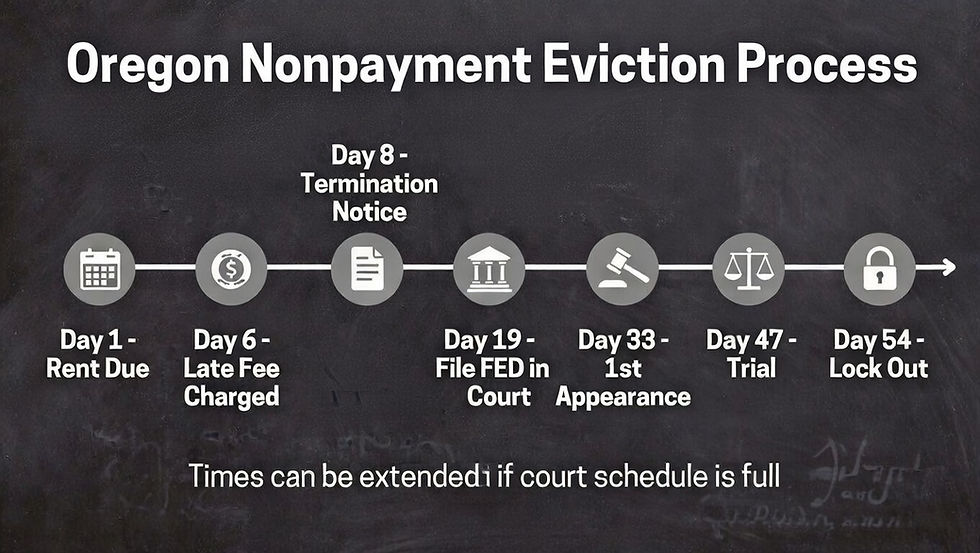
Nonpayment is by far the most common eviction type right now, so let's walk through the compliant process. We'll use the classic example: rent due on the 1st of the month.
Days 1-4: Rent is due on the 1st. You can charge late fees starting Day 5 if your lease allows (and it should—keep them reasonable per ORS 90.260).
Day 5 Option: Serve a 13-day notice to pay or vacate (on or after Day 5).
Day 8 Option: Serve a 10-day notice (on or after Day 8). Both expire on the same day—Day 18 in our example.
Critical: You must include the current state "Notice Re: Eviction for Nonpayment of Rent" form with your notice—it's been updated effective January 2026, so grab the latest from the Oregon Judicial Department site.
Service matters—use a professional process server for proof. Personal delivery or post-and-mail are safest. Documentation is your best friend here; one typo or missing form, and poof—case dismissed.
Day 19: If unpaid, file your Forcible Entry and Detainer (FED) complaint at the county courthouse where the property is. Bring everything: lease, ledger, notices, proof of service.
First Appearance: Usually set 15+ days after filing. This is your golden opportunity—most cases resolve here with a stipulated agreement. Offer a payment plan with teeth (like automatic eviction if missed), or a move-out date. Tenants can still pay in full up to trial and stay (you must accept rent, but can recover filing fees).
Trial (if needed): Another 15-30 days out. Tenant pays in full? Case dismissed, but you can charge filing fees.
Judgment and Lockout: If you win, get a writ; sheriff handles lockout (plan for delays—Multnomah can take 3-4 weeks right now due to volume).
Pitfall alert: Accept partial payment without a written agreement waiving nothing, and you might restart the clock. Always document. And connect tenants to resources like 211 early—it shows good faith and can strengthen your position if it goes to court.
Prevention Strategies: Cheaper and Smarter Than Eviction
Here's the truth I've learned the hard way: Prevention beats eviction every time. A thorough screening upfront—income verification (at least 3x rent), rental references, credit and criminal checks (fair housing compliant, of course)—sets you up with reliable tenants.
Clear lease policies on late fees, grace periods (if any), and payment plans help too. Then, communicate early: At the first late payment, reach out kindly but firmly. Offer reasonable plans, point them to assistance. One landlord I know caught a tenant slipping early, worked a plan tied to their paycheck schedule, and avoided eviction entirely. Regular property inspections and open lines keep small issues from snowballing.
Best Practices and Risk-Reduction Tips
Document everything—notices, texts, emails, photos, ledgers. It's your shield against tenant defenses. Use pro servers. At first appearance, push for stipulated agreements—they're enforceable without trial. Train your team on current forms; one outdated notice can tank your case.
And remember compassion where it fits—connecting a struggling tenant to aid isn't weakness; it's smart business. It might resolve things without court, preserving your cash flow and their housing.
Folks, this Oregon eviction surge 2026 is tough, but we're professionals. Stay compliant, proactive, and preventive, and we'll weather it. Evictions protect our rights, but prevention protects our bottom line. Reach out to PAROA if you need forms or advice—we're in this together.
Written by Christian Bryant,
President of PAROA and Northwest Rental Property Management (NWRPM)
If you’re a landlord or property manager in Oregon looking for practical education, up-to-date landlord forms, local expertise, and a community that truly has your back, join PAROA today at www.paroa.org—I’m proud to serve as its president, and our membership gives you direct access to classes, landlord forms, legislative updates, and a network of professionals who understand the unique challenges of renting in the Portland metro and across the state.
For owners with properties in the Portland Metro or Central Oregon areas who want hassle-free eviction processing or full-service property management—especially during tough times like the current surge—consider Northwest Rental Property Management at www.NWRPM.com, where I also serve as president. Our team knows Oregon law inside and out, handles every detail compliantly, and helps protect your cash flow so you can focus on growing your portfolio instead of fighting in court.
Sources:
Oregon Judicial Department Residential Eviction Forms: https://www.courts.oregon.gov/forms/Pages/Residential-Eviction.aspx
Updated Notice Re: Eviction for Nonpayment of Rent (effective Jan 2026): https://www.courts.oregon.gov/services/online/Documents/eFile/OJD-Memo-Updated_Notice_Re_Nonpayment.pdf
ORS Chapter 90: https://www.oregonlegislature.gov/bills_laws/ors/ors090.html
ORS Chapter 105: https://www.oregonlegislature.gov/bills_laws/ors/ors105.html
Eviction Lab Oregon Data: https://evictionlab.org/
Axios Portland (Feb 2026): https://www.axios.com/local/portland/2026/02/11/oregon-evictions-five-year-high-january
KEZI News on Record Evictions: https://www.kezi.com/news/local/record-evictions-in-oregon-highlight-urgent-housing-crisis/article_f70f260f-9341-4b36-9419-246a32bb1c62.html
PAROA HelpLine Logs and Class Transcripts (internal resources)


.png)

Comments