


NY Appellate Court Strikes Down Mandatory Section 8 Acceptance as Unconstitutional: NY Section 8 ruling Oregon landlords Key Lessons for Oregon Landlords
Hey there, fellow Portland landlords and property managers across Oregon. It’s Christian Bryant here, and if you’re like me, you’re always keeping an eye on court decisions that could shake up how we run our rental businesses. Just last month—March 5, 2026—the New York Appellate Division, Third Department, dropped a unanimous bombshell in People of the State of New York v. Commons West, LLC. They ruled that New York’s law forcing landlords to accept Section 8 vouchers is facially unconstitutional because it compels private property owners into warrantless government searches.
Now, before you think “that’s New York, not us,” hold on. Oregon has had nearly identical “source of income” protections on the books since 2014 under ORS 659A.421, and our local Public Housing Authorities (PHAs) like Home Forward in Multnomah and Clackamas Counties or the Housing Authority of Washington County run the same Housing Quality Standards (HQS) inspections tied to Housing Assistance Payment (HAP) contracts. This NY Section 8 ruling Oregon landlords are watching isn’t binding here, but it’s highly persuasive on a core constitutional issue: private landlords shouldn’t be forced to hand over “full and free access” to their units and records without a warrant. And right now, with spring lease renewals and policy reviews happening, it’s the perfect time to talk about what this means for us in the Portland metro area and beyond. (Quick note from our HelpLine Logs: no big recent spike in Section 8 or voucher discrimination calls, so this isn’t an everyday helpline fire like late rent or deposits—but the national buzz around this case makes it worth our attention.)
Let’s break it down step by step, the way we do in our PAROA classes—clear, practical, and with real-world Oregon examples so you can apply it tomorrow.
First, a quick history of the New York case. Back in 2019, New York passed Executive Law § 296(5)(a)(1), banning source-of-income discrimination to boost Section 8 participation amid their housing crunch. The law defined “source of income” to include federal vouchers, effectively requiring landlords to accept them or face penalties. In 2020, two voucher-holding tenants in Ithaca complained that Commons West, LLC (and other local owners) wouldn’t rent to them because of their Section 8 status. The New York Attorney General filed suit under Executive Law § 63(12), seeking injunctions, unit set-asides, monitoring, and fines. The landlords fought back, arguing the law unconstitutionally forced them into the federal Section 8 program.
A lower court sided with the landlords in 2023, and the appellate panel just affirmed it unanimously. The state tried to defend the law, but the court wasn’t buying it.
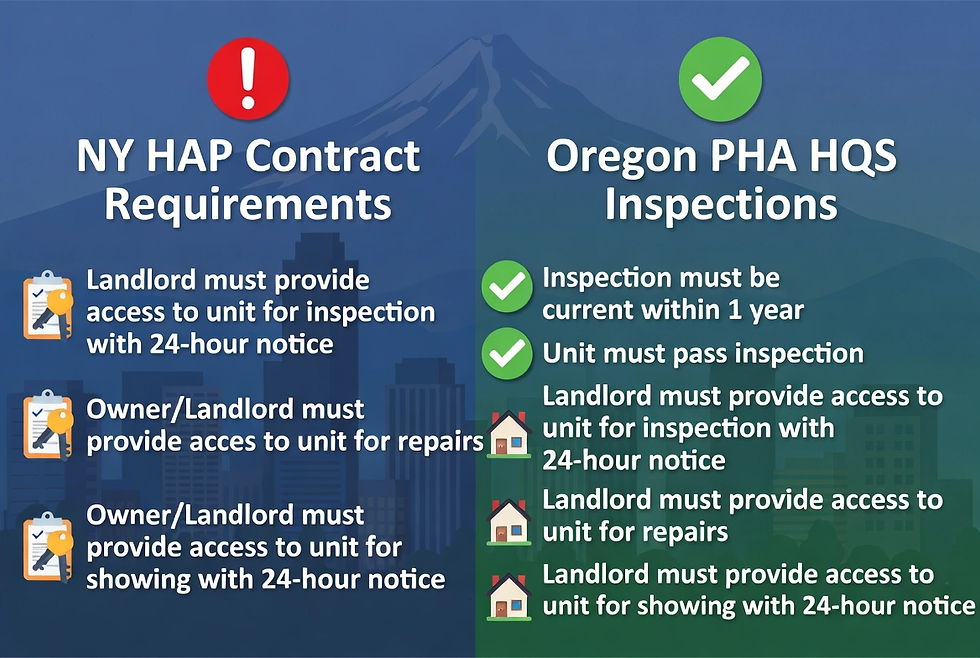
Core arguments boiled down to this: Landlords said the law compels them to sign the federal HAP contract, which demands “full and free access” to the unit, common areas, equipment, and records for initial inspections plus biennial (or complaint-driven) HQS checks—no warrant, no real consent. The state countered that inspections are “voluntary,” part of a closely regulated industry, or fixable via a new Housing and Community Renewal (HCR) policy allowing written objections and warrants in some counties. Landlords also noted the inspections have no real limits on frequency, scope, or timing.
The judges’ reasoning was crystal clear and unanimous. They declared the law facially unconstitutional under the Fourth Amendment because it indirectly compels warrantless searches. Citing Sokolov v. Village of Freeport (1981) and Los Angeles v. Patel (2015), the court explained that when a statute effectively requires consent to inspections before you can even challenge them, precompliance review is meaningless. Key quote: “A landlord is required to sign the HAP contract, thereby expressly consenting to all searches before any opportunity to challenge a search would arise.” They also shot down the state’s fixes—the HCR policy isn’t statewide or binding on every PHA, and tenant “consent” doesn’t save a facial challenge when the law itself authorizes the intrusion. The AG is appealing to New York’s highest court, so stay tuned, but for now this is a big win for property rights.
And now a couple shameless plugs.
If the administrative burdens and inspection headaches of mandatory voucher programs have you rethinking your portfolio, Northwest Rental Property Management (NWRPM) specializes in full-service management and professional eviction processing here in the Portland metro and Central Oregon. We handle the paperwork, compliance checks, and tenant issues so you don’t have to—especially when fair-housing rules feel like they’re constantly evolving. Give us a call and let us take the stress off your plate.
If you’re not already a member of www.PAROA.org, now’s the perfect time to join—especially with fair-housing and source-of-income issues like this one making headlines. We provide landlord forms, monthly education, advocacy, and a supportive network of fellow owners so you’re never navigating these challenges alone.
NY Section 8 ruling Oregon landlords: What this means for Oregon landlords right now
Our statute—ORS 659A.421—explicitly prohibits refusing to rent (or discriminating in terms) because of “source of income,” which includes federal rent subsidies under 42 U.S.C. 1437f (that’s Section 8) and any other housing assistance. No amendments since the last legislative tweaks; the law is current and unchanged as of the 2025 Oregon Revised Statutes edition. Local PHAs still require landlords who accept vouchers to sign HAP contracts and grant access for HQS inspections—initially before move-in and then periodically (usually annually or biennially). Home Forward in Multnomah County, for example, can be pretty prompt, but Washington County’s PHA sometimes has longer wait times for inspections, which can delay your lease start.
Refusing a qualified voucher applicant solely because of the voucher is still unlawful and can bring complaints to the Fair Housing Council of Oregon or civil penalties.
The good news? The NY logic could absolutely support a future constitutional challenge here. It’s not binding outside New York, but federal Fourth Amendment principles travel well. No identical Oregon appellate cases exist yet, but landlord groups nationwide (including ours) are watching. Don't be surprised if you see one of the large and well funded organizations or management companies or rental unit investment firms in Oregon bring a case about this up through the Oregon court system. Voluntary participation still works great for many—guaranteed rent from the PHA is nice—but forced participation treats your private property like a public utility. That’s the core property-rights issue.
Is this realistic precedent for Oregon or other states? Absolutely persuasive on the constitutional point. Oregon courts have cited out-of-state decisions on similar housing issues before. If a Portland-area landlord (or group) wants to test the waters, especially given county-level PHA differences in inspection burdens, this ruling gives strong ammunition. In the meantime, keep participating voluntarily where it makes financial sense, but know your rights.
A smart, proactive step our state and local housing authority administrators could take right now would be to get ahead of any potential legal challenges by reaching out to stakeholders—landlords, property managers, and investors like myself—to explore ways to improve the program voluntarily.
Instead of waiting for costly litigation, they could redesign elements of the Section 8 process to reduce administrative burdens and inspection intrusions, ultimately creating a program that landlords actually want to participate in. When participation is truly voluntary and mutually beneficial, everyone wins: tenants get stable housing, and landlords gain reliable payments without feeling like their private property rights are being compromised.
Let’s get practical with best practices every Oregon landlord should follow today. First, screen voucher applicants exactly the same way you screen everyone else: same credit score minimum, same criminal background check, same rental history standards. You can reject for valid non-source of income reasons—like insufficient verifiable income to cover the tenant portion, poor references, or past evictions—as long as you apply those rules uniformly and document everything. Second, keep detailed records: notes from every showing, application responses, and denial letters that clearly state the non-voucher reason. Third, know your PHA’s specific rules. Home Forward’s HQS checklist is public; review it before you commit so there are no surprises. Fourth, if you’re considering a challenge, document the inspection burden—photos, emails about delays, extra costs—and reach out to PAROA's members only free landlord helpline for detailed assistance and guidence.
Here’s a quick checklist you can keep handy:
What you must still do today (Oregon law):
Consider all applicants without regard to voucher status.
Sign the HAP contract and allow HQS access if you accept the tenant.
Maintain habitability standards that meet or exceed PHA requirements.
What could change if an Oregon court follows the NY logic:
Ability to decline vouchers without fear of discrimination claims.
No more compelled “full and free access” without a warrant.
Stronger private property protections overall.
Voluntary participation still has upsides—steady rent payments and a built-in tenant pool—but the administrative load and inspection intrusions are real. A little humor helps: dealing with a surprise HQS inspector can feel like your mother-in-law showing up with a white-glove test and a federal clipboard. Not fun, but manageable when you’re prepared. Sometimes they will also note tenant problems or violations and actually help you enforce their rules. In Oregon if a tenant is successfully evicted they are supposed to lose their eligibiloity for section 8 rent assistance.
Bottom line: this New York ruling is a reminder that property rights matter, and voluntary programs work best for everyone. Keep monitoring the NY appeal, watch for any Oregon legislative moves in the upcoming 2027 long session, and stay in touch with your PHA and PAROA. If questions pop up, reach out—we’re here to help.
Written by Christian Bryant,
President of both PAROA (Portland Area Rental Owners Association) and
Northwest Rental Property Management (NWRPM).
As a longtime Oregon landlord myself, I believe in practical education that protects your rights while keeping you compliant.
If you’re not already a member of www.PAROA.org, now’s the perfect time to join—especially with fair-housing and source-of-income issues like this one making headlines. We provide landlord forms, monthly education, advocacy, and a supportive network of fellow owners so you’re never navigating these challenges alone.
Rental property owners with properties in the Portland Metro and Central Oregon areas facing voucher-related headaches, compliance questions, or eviction needs should seriously consider hiring www.NWRPM.com for professional full management or targeted eviction processing. We live and breathe these laws every day, so you don’t have to.
Sources:
Full NY Appellate Decision (March 5, 2026): https://decisions.courts.state.ny.us/ad3/Decisions/2026/CV-23-1255.pdf
Oregon Revised Statutes, ORS 659A.421: https://www.oregonlegislature.gov/bills_laws/ors/ors659a.html
Fair Housing Council of Oregon – Source of Income flyer: https://fhco.org/learn-about-the-protected-class-of-source-of-income/
HUD Section 8 HQS inspection overview: https://www.hud.gov/program_offices/public_indian_housing/programs/hcv/inspection
Phillips Nizer LLP analysis: https://www.phillipsnizer.com/new-york-appellate-court-invalidates-section-8-source-of-income-requirement
Harris Beach Murtha summary: https://www.harrisbeachmurtha.com/insights/compulsory-participation-in-section-8-housing-program-deemed-unconstitutional/
Oregon 2026 legislative recap: https://www.paroa.org/post/oregon-2026-legislative-session-passed-housing-bills-a-wrap-up-for-landlords-and-investors


.png)

Hopefully Oregon will follow suit. What still bothered me is you repetedly saying "voluntary participation". When you are forced into accepting a section 8 applicant, nothing is voluntary anymore.