


Tenant Screening Best Practices in 2026 Oregon: Compliant Application Processes, Fair Housing Compliance, and Avoiding Costly Discrimination Claims for Portland-Area Landlords
Hey there, fellow Portland-area landlords and property managers. It’s Christian Bryant here, and if you’re like most of us, spring 2026 has you buried in rental applications already. The flowers are blooming, the “For Rent” signs are popping up, and the phones are ringing off the hook. With Oregon’s 9.5% rent cap squeezing cash flow tighter than ever, picking the right tenant isn’t just important—it’s make-or-break for keeping your investment healthy and your stress levels manageable.
tenant screening best practices in 2026 Oregon
One sloppy screening decision, one inconsistent denial, or one overlooked fair housing rule can land you in front of BOLI with a discrimination complaint that costs thousands in legal fees, refunds, and lost rent. I’ve heard it on the PAROA HelpLine more times than I can count: “I just went with my gut on that one applicant…” Don’t be that landlord. The good news? A clear, written, objective, and consistently applied screening process is your best defense—and your best offense for landing reliable, long-term tenants who pay on time and treat your property like their own.
And now a couple shameless plugs:
If managing all this compliance, paperwork, and tenant drama sounds like more than you want on your plate, Northwest Rental Property Management (NWRPM) specializes in full-service residential property management and professional eviction processing across the Portland Metro and Central Oregon areas. We handle the headaches so you can focus on the returns—reach out at www.NWRPM.com to see how we can protect and grow your portfolio.
For education, up-to-date landlord forms, training, and peer support on these exact compliance challenges, join PAROA at www.paroa.org. Our resources and HelpLine give members the practical tools they need to navigate Oregon’s rules confidently and avoid expensive mistakes.
Let’s walk through exactly how to do tenant screening right in 2026, with plenty of real-world Oregon examples, step-by-step guidance, common pitfalls, and practical tips drawn from years of helping landlords just like you.
Current Legal Framework in Oregon (2026 Updates)tenant screening best practices in 2026 Oregon
Oregon’s baseline rules come from the Residential Landlord and Tenant Act, primarily ORS Chapter 90. Under ORS 90.295, you can charge an applicant screening fee only to cover actual costs (or the customary amount charged by professional services), and you may collect only one such fee from an applicant in any 60-day period across all your units. You must give a receipt and, if you use a third-party service, promptly provide confirmation and a copy of the report receipt.
You also must disclose your screening criteria before collecting any fee or hold deposit. Criteria have to be in writing, objective, and applied the exact same way to every applicant—no exceptions, no “I just had a feeling about this one.”
Federally, the Fair Housing Act protects race, color, national origin, religion, sex, familial status, and disability. Oregon layers on more: marital status, sexual orientation, gender identity, and source of income (including Section 8 or other rental assistance). In May 2025, SB 599 took effect and made immigration status a distinct protected class. You cannot inquire about or discriminate based on an applicant’s immigration or citizenship status, the type of identification documents they provide (beyond what’s reasonably needed to confirm identity), or threaten to disclose that information to harass or intimidate. This is a big one for 2026—treat everyone the same regardless of how they document their identity.
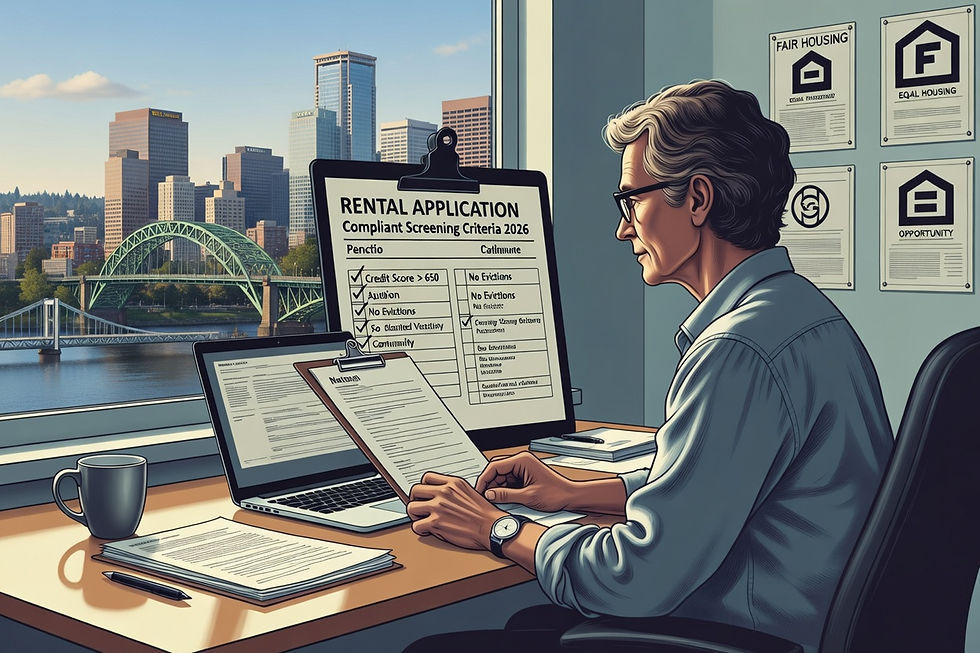
In the City of Portland, the FAIR Ordinance adds strict low-barrier screening requirements. You must accept supplemental evidence and mitigating circumstances, follow flexible income standards, process applications in a specific order, and avoid blanket bans on criminal history—individualized assessments only. Recent laws like HB 3521 (effective Jan. 1, 2026) also tie into the bigger picture by restricting hold deposits to approved applicants only and requiring faster refunds in certain cases, including habitability issues.
Spring leasing season means higher volume and higher risk of mistakes. Consistency and documentation are your shields in Oregon’s tenant-friendly environment.
Two Important New 2026 Laws Affecting Screening and Tenant Information
Two newer laws passed this year deserve special mention because they directly impact how you handle applications and information.
First, a law now requires landlords to allow paper applications if an applicant requests one. If you use an online tenant portal or digital-only process, you must provide a printable version on your website or mail/email a printed or printable copy within three days of a written request. You must process paper applications in the same manner and with the same priority as digital ones—promptly entering the information if needed. This helps bridge the digital divide for older adults, people with disabilities, or anyone who prefers analog methods. Have paper forms ready and treat them exactly like online submissions to stay compliant.
Second, a tenant confidentiality law (HB 4123) restricts landlords from sharing sensitive tenant or applicant information—such as Social Security numbers, immigration status, medical or disability records, income details, or contact information—without the person’s written consent. Violations can result in penalties up to twice the monthly rent paid to the affected individual. The good news for screening? Sharing information for legitimate purposes like background checks, credit reports, court orders, insurance claims, maintenance services, or other required administrative and legal proceedings is explicitly exempt. You can still use reputable third-party screening services and share necessary data with them, as long as you follow FCRA rules and don’t disclose beyond what’s needed. Document consents where required and keep sharing limited to business necessities. These updates reinforce the importance of clear policies and careful record-keeping.
Step-by-Step Compliant Screening Process
Here’s the exact process I recommend—and the one that holds up if you ever face a complaint.
Develop and document written objective criteria. Create a one-page “Screening Criteria Disclosure” that lists every factor you’ll consider: minimum verifiable income (typically 2.5–3x rent, adjusted per Portland’s table where applicable), credit score/history (with clear explanations of what’s acceptable), rental history (no recent evictions or repeated violations), criminal convictions (case-by-case only—no blanket bans on felonies or misdemeanors; consider time since offense, nature, and mitigating evidence), and any other neutral factors. Never use subjective terms like “good character” or “reliable vibe.”
Disclose criteria before any fees or hold deposits. Post the criteria in your ads, hand them to every inquirer, and require acknowledgment before accepting an application fee. In Portland, you must also provide the specific FAIR notices about rights and responsibilities. Offer paper versions immediately upon request.
Accept and process applications in order received. Especially critical in Portland—first complete, qualified application gets first consideration. Document the exact date and time each one arrives, whether paper or digital.
Screen consistently and thoroughly. Use the same reputable third-party service (FCRA-compliant) for everyone or do manual checks the exact same way. Verify income with pay stubs, tax returns, or employer letters. Check rental history by actually calling prior landlords (with permission). For criminal history, run a lawful check and conduct an individualized assessment: How long ago? What was the offense? Any evidence of rehabilitation or mitigating circumstances?
Evaluate supplemental evidence and mitigating circumstances fairly. This is huge under FAIR and best practices statewide. If an applicant provides rental references, proof of steady income from non-traditional sources, explanations of past credit issues (medical bills, job loss, etc.), or evidence of rehabilitation, you must genuinely consider it. Have a simple matrix or checklist to document your review—date, evidence received, how it factored in.
Communicate clearly and keep records. Respond promptly. Retain every application, screening report, notes, and communications for at least 3–4 years (longer if a complaint arises). Use secure storage that complies with FCRA, data privacy rules, and the new confidentiality requirements.
Pro tip: Many successful landlords use a scoring matrix that assigns points or clear pass/fail thresholds for each criterion. It removes emotion and strengthens your defense. If questions come up about any of these steps, remember that PAROA members can use the free members-only landlord helpline for quick, practical guidance.

And now a couple shameless plugs:
Struggling with the volume of applications or worried about compliance during this busy spring season? Northwest Rental Property Management (NWRPM) offers expert tenant screening, full residential property management, and professional eviction processing tailored for Portland Metro and Central Oregon owners. Let our team handle the details while you enjoy the peace of mind—visit www.NWRPM.com today.
For ongoing support, including landlord forms, training on these compliance updates, and access to the free HelpLine, join PAROA at www.paroa.org. It’s one of the smartest moves you can make as an Oregon landlord.
What You Can and Cannot Consider (Protected Classes & Red Flags)
You can consider: verifiable income, credit history, rental references, criminal convictions (with individualized review), and lawful occupancy limits.
You cannot consider (or use as proxies): race, color, religion, sex, national origin/immigration status, disability, familial status, marital status, sexual orientation, gender identity, source of income, or any protected class. No asking about immigration status. No blanket “no felons” policies. No different standards for families with kids or people with disabilities (reasonable accommodations required). Avoid subjective red flags like “looks messy” or assumptions based on appearance, accent, or name.
For criminal history, focus on relevance to tenancy—recent violent or property crimes may be legitimate concerns after review; old, non-violent offenses with strong mitigating evidence often should not result in automatic denial.
City of Portland FAIR Ordinance vs. Other Areas
The City of Portland’s FAIR Ordinance applies to rental properties within Portland city limits (which span primarily Multnomah County but also touch small portions of Washington and Clackamas Counties). These rules are stricter than general state law: mandatory supplemental evidence review, flexible income verification (including alternative sources), no automatic denials on many criminal or credit issues, and specific processing order. Outside Portland city limits—even in the broader Portland Metro area— you follow state ORS 90 rules, which still require consistency and non-discrimination but give a bit more flexibility on income multiples and criminal assessments as long as they’re objective and documented.
Always confirm the exact city boundaries for each property. A single mistake on a Portland unit can trigger city penalties. Real example: One landlord denied an applicant solely for an old misdemeanor without reviewing the provided character letters and proof of stable employment. In Portland, that led to a complaint. Another used the same matrix everywhere, documented mitigating evidence reviews, and sailed through an inquiry with zero issues.
Common Pitfalls & How to Avoid Costly Claims
Inconsistent application is the #1 killer—screening your buddy’s cousin differently than everyone else. Subjective decisions (“he seemed nice”). Poor documentation (no notes on why you denied someone). Mismatches between your ad and criteria. Using outdated forms that don’t reflect 2025–2026 changes like SB 599, the new paper application requirement, or tenant confidentiality rules. Failing to provide adverse action notices when using consumer reports (FCRA requires specific wording and reasons).
Avoid them by: training anyone who touches applications, using checklists, auditing a few files monthly, consulting an attorney when drafting or updating criteria (and remember, PAROA members can also use the free members-only landlord helpline for practical advice), and staying current on city vs. state differences. Spring volume makes shortcuts tempting—resist.
Best Practices & Tools
Adopt a screening matrix template (available via PAROA landlord forms).
Use professional, FCRA-compliant services ethically—never share reports improperly, and limit disclosures under the new confidentiality law.
Develop polite communication scripts: “Thank you for applying. We received X applications ahead of yours and will notify you as soon as we decide.” Offer paper options right away.
Run resident referral programs with clear incentives—great tenants often know other great tenants.
Retain records securely and know your data breach and confidentiality obligations.
These practices go beyond statutes and reduce turnover dramatically.
Denial Process & Adverse Action Notices
If you deny (or approve with conditions), act quickly and document everything. For consumer report-based decisions, send a proper adverse action notice with the FCRA-required information: the decision, contact info for the reporting agency, and the applicant’s rights. Under FAIR and state rules, provide clear, specific reasons tied to your disclosed criteria. Keep it factual and neutral—never mention protected characteristics.
This is one area where many landlords get themselves in trouble by saying too much or using the wrong wording. The good news is that the PAROA forms store has a standard denial letter form you can purchase that makes most denials as easy as checking boxes on the form. It minimizes the risk of accidentally saying something you didn’t know you shouldn’t say while still meeting all legal requirements. A well-written denial letter has saved many landlords from complaints.
Conclusion & Checklist: Your 2026 Spring Screening Compliance Checklist
Written, objective criteria disclosed upfront (including paper application option)?
All applications processed consistently and in order received?
Mitigating evidence and supplemental info genuinely reviewed and documented?
Immigration status and all protected classes ignored in decisions?
Proper receipts, notices, FCRA adverse action letters, and confidentiality limits followed?
Records retained securely?
Portland city-specific FAIR rules followed where applicable?
Run through this before you approve or deny anyone this season. Do it right, and you’ll fill units faster with quality tenants, sleep better at night, and stay far away from costly claims.
Proper tenant screening isn’t about being overly picky—it’s about protecting your investment while treating every applicant fairly and lawfully. In Oregon’s regulatory environment, the landlords who thrive are the ones who embrace transparency, consistency, and documentation.
Stay compliant, stay consistent, and here’s to a smooth leasing season with great tenants.
Written by Christian Bryant,
President of both PAROA (Portland Area Rental Owners Association) and
Northwest Rental Property Management (NWRPM).
If you’re not already a member, you should join www.PAROA.org. We provide practical landlord forms, ongoing training on exactly these compliance issues, a busy HelpLine for quick answers, and a community of experienced owners who’ve been through it all. Whether you’re a small landlord or portfolio investor, PAROA membership gives you the tools and support to navigate 2026 rules confidently and profitably.
Rental property owners with properties in the Portland Metro and Central Oregon areas facing screening challenges or just wanting to reduce risk and maximize returns should seriously consider hiring www.NWRPM.com. Our team manages the full tenant screening process, compliance, leasing, and ongoing management (or targeted eviction processing) so you avoid the pitfalls that trip up so many owners—especially during busy seasons like this spring.
Sources (all accessed/verified March 2026):
Oregon Revised Statutes Chapter 90, including ORS 90.295 (Applicant Screening Charges) and related sections: https://oregon.public.law/statutes/ors_chapter_90
SB 599 (immigration status protections, effective May 28, 2025)
HB 3521 (hold deposit changes, effective Jan. 1, 2026)
Portland.gov Application & Screening Rules / FAIR Ordinance details and Portland City Code 30.01.086: https://www.portland.gov/phb/rental-services/application-and-screening and https://www.portland.gov/code/30/01/086
Oregon legislative information on paper application requirements and HB 4123 (tenant confidentiality with screening exceptions): https://olis.oregonlegislature.gov
BOLI Fair Housing resources: https://www.oregon.gov/boli/civil-rights/pages/fair-housing.aspx
Federal FCRA guidance for landlords (FTC/CFPB materials)
Fair Housing Council of Oregon resources on criminal history and protected classes


.png)

Comments