


Oregon For-Cause Termination 2026: Write the Notice So the Case Survives
This is the article I wish every Oregon landlord read before they typed a 30-day notice in Word.
Oregon for-cause termination 2026 is not a mood. It is a statute with a checklist. Miss one line on that checklist and the judge does not weigh how bad the tenant was. The court dismisses the case because the notice itself was invalid. You start over. The tenant is still there. And if you guessed wrong about “they can’t possibly fix this,” the Oregon Supreme Court already told you that guess does not count.
I am going to walk the tracks, the KKMH rule, and the lines that have to be on the paper. I am not going to hand you a homemade notice to copy. Use a current Portland Area Rental Owners Association (PAROA) landlord form, or sit down with an Oregon landlord-tenant attorney on anything that is not a clean, ordinary violation. This is education, not legal advice for your file.
Pick the right statute first
Before anyone writes a date on a form, name the statute. Oregon gives you different notices for different problems. They are not interchangeable.
ORS 90.392 is termination for cause. The three listed causes are a material violation of the rental agreement (including unpaid late charges or utility charges), a material violation of the tenant duties in ORS 90.325, and failure to pay rent. That last one is allowed on the 90.392 list. It is usually the wrong tool anyway. I will come back to that.
ORS 90.394 is the purpose-built nonpayment-of-rent notice: 10 or 13 days on an ordinary tenancy, served no earlier than the statute allows, with the amount due and the date and time to pay it.
ORS 90.396 is the 24-hour track. Serious threat or infliction of substantial personal injury, reckless endangerment, substantial intentional damage, certain application fraud, or an act that is “outrageous in the extreme.” The statute says an outrageous act is more extreme than the conduct that supports a 30-day 90.392 notice. A loud party, an extra roommate, a messy yard, and “I am sick of this tenant” are not 24-hour facts.
Use the 24-hour form on a 30-day problem and you handed the tenant a dismissal.
Portland’s PCC 30.01.085 relocation dollars attach to qualifying-landlord-reason and no-cause stories, not to an ordinary tenant-cause 90.392 notice. Do not mix “I want the unit for my kid” into a for-cause paper.
What KKMH actually said
In May 2025 the Oregon Supreme Court decided KKMH Properties, LLC v. Shire, 373 Or 676 (2025). The landlord served a 30-day for-cause notice for “extensive” damage from “277+ guinea pigs running free range.” The notice did not say the violation could be cured. The landlord’s theory was simple: nobody is curing 277 guinea pigs in 14 days, so why pretend?
The Court reversed. Under ORS 90.392(3)(c), if the tenant has a legal right to cure under subsection (4), the notice must say the violation can be cured, describe at least one possible remedy, and designate the cure date. The tenant has that legal right on every 90.392 violation except a repeat violation under subsection (5). The landlord does not get to skip the sentence because a cure looks impractical.
Read that again. “They will never actually fix it” is not a drafting rule. If they do not fix it by the cure date, the notice does its job and you file. If you leave the cure sentence off, you do not get to file on that paper.
The legislative annotations to ORS 90.392 now say the same thing in one line.
How an Oregon for-cause termination 2026 notice actually has to read
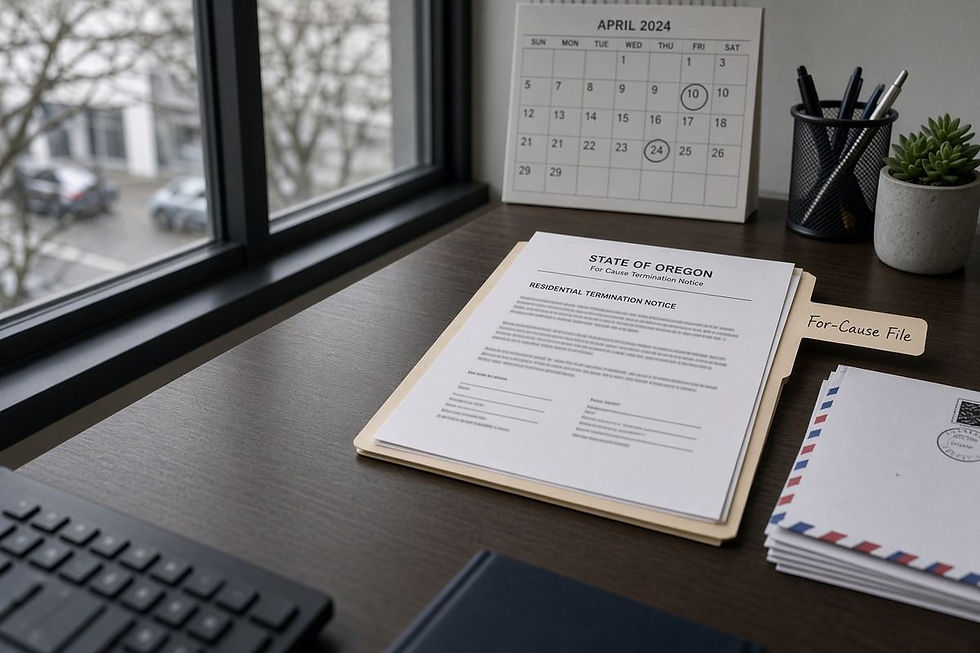
For a first 90.392 notice that is not a subsection (5) repeat, the paper has to do three things. All three.
One. Specify the acts and omissions. Dates. What happened. Which clause or which tenant duty. “You violated the lease” is not a specification. “Unauthorized occupant John Doe has resided in the unit since August 3, 2026, in violation of paragraph 8 of the rental agreement” is a specification. If you cannot write the facts without adjectives, you are not ready to serve.
Two. State that the rental agreement will terminate on a designated date not less than 30 days after delivery. Week-to-week tenancies are a shorter clock under subsection (6). Everyone else is 30 days on this track. Delivery is ORS 90.155. If you serve by first-class mail only, the statute extends the minimum period by three days and the notice has to include that extension.
Three. If the tenant can cure under subsection (4) — and after KKMH, assume they can unless you are on a true subsection (5) repeat — state that the violation can be cured, describe at least one possible remedy, and designate the cure date.
The cure date is not the same date as the termination date. For ongoing conduct, the cure date must be at least 14 days after delivery (plus the mail-only extra days if you mailed only). For a separate, distinct act that is not ongoing, the cure date can be as early as delivery. Conduct is ongoing if it is constant, persistent, or repetitive enough that a reasonable person would call it ongoing. An extra occupant who is still sleeping there is ongoing. A one-night party last Saturday that is over is not.
The remedy has to be a real one: remove the extra occupant, stop the conduct, pay the stated late charge, repair the damage or pay the reasonable cost to repair it. “Fix everything or else” is not a described remedy.
If they cure by that date, the rental agreement does not terminate. That is the point of the statute. You do not get to keep the notice in your back pocket after a real cure and file anyway.
Every termination notice under Chapter 90 also has to carry the veteran information required by ORS 90.391 and ORS 408.515. Current association landlord forms already print that block. A homemade letter usually forgets it.
Triple-check the form before it leaves the desk
I teach this in the eviction-and-termination-forms class, and it belongs on every 90.392 paper too. A tiny typo can dismiss the case and put you back at square one. The tenant’s middle initial is J and you put K. The address is northeast and you typed southeast. It is 127th and a moment of dyslexia makes it 172nd. You fill out everything and forget the unit number, so all you have is the building address. Any one of those will get the case thrown out.
The rule is you triple-check the form. Literally.
First check: you are looking at the info in the tenant file and you fill out the form so that it matches. That is the first pass.
Second check: go back over it. Make sure it is all right.
Third check: do not do it right away. Set the form down and go do something else. Get your brain off of it and look at it with fresh eyes. Or, if you are in an office, hand it to someone who understands what is supposed to be on there and let them do the third check.
Same habit on a 90.394 rent notice, where the dollar line has to be rent and only rent. I have watched a $230 mix of late fees and utilities on that line cost a landlord the case, the tenant’s attorney fee, and six weeks of calendar. Triple-check.
The 10-day repeat notice is a second notice, not a shortcut
Subsection (5) is the only 90.392 track with no right to cure. It is narrow on purpose.
You already gave a written 90.392 notice for a prior violation. Within six months, the tenant does substantially the same act or omission. The new notice sets a termination date not less than 10 days after delivery, and no earlier than the termination date on the first notice. The tenant does not have a right to cure that subsequent violation.
You may not use subsection (5) if the only violation is failure to pay the current month’s rent.
A warning email, a text, or a 90.394 rent notice is not the prior 90.392 notice. If the first paper was defective under KKMH, you do not have a clean first notice to repeat.
Do not run unpaid rent through 90.392 just because you can
Yes, 90.392(2)(c) lists failure to pay rent as a for-cause. That does not make it the notice you want.
ORS 90.394 is the rent notice: 10 or 13 days for ordinary tenancies, amount due, date and time to pay. Hickey v. Scott, 370 Or 97 (2022) already taught Oregon that an inaccurate rent figure on a nonpayment notice can kill the case.
ORS 90.395 requires you to deliver the Judicial Department notice of rental assistance and support services with any termination notice for nonpayment, and again with the FED summons. “Nonpayment” in that section includes rent, late charges, utility charges, and other charges described in the rental agreement or in 90.392 and 90.394. It does not include damages to the premises. Fail to attach that OJD notice and the court “shall” dismiss a possession case based on nonpayment. Grab the current packet from the Oregon Judicial Department landlord-tenant forms page, not a PDF you saved in 2023.
If the problem is unpaid rent, use the rent statute and the assistance notice. Stretching it into a 30-day 90.392 does not save you from 90.395, and it makes you wait a month.
Serve it like the clock depends on it, because it does

Personal delivery. First-class mail. Or, if the written rental agreement allows it both directions, first-class mail plus posting on the main entrance. Electronic mail only if you have the post-move-in addendum the statute describes — and a termination notice sent by email still has to go first-class mail as well.
Certified mail is not a substitute for first-class mail. A text is an extra, not a method. If you mail only, add the extra days and say so on the notice. Current PAROA landlord forms are built for those boxes. Fill the boxes. Do not invent a hybrid.
Name every adult tenant. “Et al and all others” is on the form for a reason. Keep the proof: photo of the posted copy, copy of the mailed envelope, a log of the date and method.
and now a couple shameless plugs.
If you are staring at a lease violation and you are not sure which notice you are holding, that is exactly why the Portland Area Rental Owners Association (PAROA) exists. Members get current Oregon landlord forms, classes that walk the 14/30 and 24-hour tracks, and a helpline that has been taking termination-for-cause calls all year. Join at www.paroa.org.
If you would rather not be the person who has to pick the statute at 9 p.m., Northwest Real Estate and Property Management (NWRPM) runs this process for owners in the Portland Metro and Central Oregon. Notices, service, file notes, and the FED when the cure date expires. www.nwrpm.com.
After the paper goes out
Calendar the cure date and the termination date. On the cure date, look. If they cured, the notice is done. If they did not, you wait until the termination date and then you file an FED. You do not change the locks. You do not shut off the heat. You do not stack a second homemade notice on top of the first one “just to be safe” unless you know why you are doing it.
If they send a written repair complaint and you serve for-cause four days later, you have a different problem. We already covered that Multnomah verdict in Avoiding Oregon Landlord Retaliation. A real violation can still be a retaliatory notice if the timing and the file look like payback. Document the violation when it happens, not when you get angry.
The $725,000 Washington settlement was a different statute in a different state. The Oregon version is quieter: a dismissed FED and a tenant who now knows the first notice was defective.
What I want you to do this week
Do not draft a 90.392 notice from memory. Pull the current PAROA landlord form. Write facts, not feelings. Triple-check it the way the class teaches: file to form, go back over it, then set it down and look with fresh eyes — or hand it to somebody else. Put the cure sentence on every first for-cause notice unless you are on a documented subsection (5) repeat. Use 90.394 plus the OJD assistance notice for unpaid rent. Leave 90.396 for the facts that statute actually lists. If the file is messy, get a second set of eyes before you serve.
Oregon for-cause termination 2026 rewards the landlord who treats the notice as the case. Treat it like a blog post, and the case will treat it the same way.
Christian Bryant
President of both the Portland Area Rental Owners Association (PAROA)
If you want the current for-cause landlord forms and someone to sanity-check the facts before you serve, join PAROA at www.paroa.org.
If you want the notice written, served, and followed into court without you living in the file, use NWRPM at www.nwrpm.com.


.png)

Comments